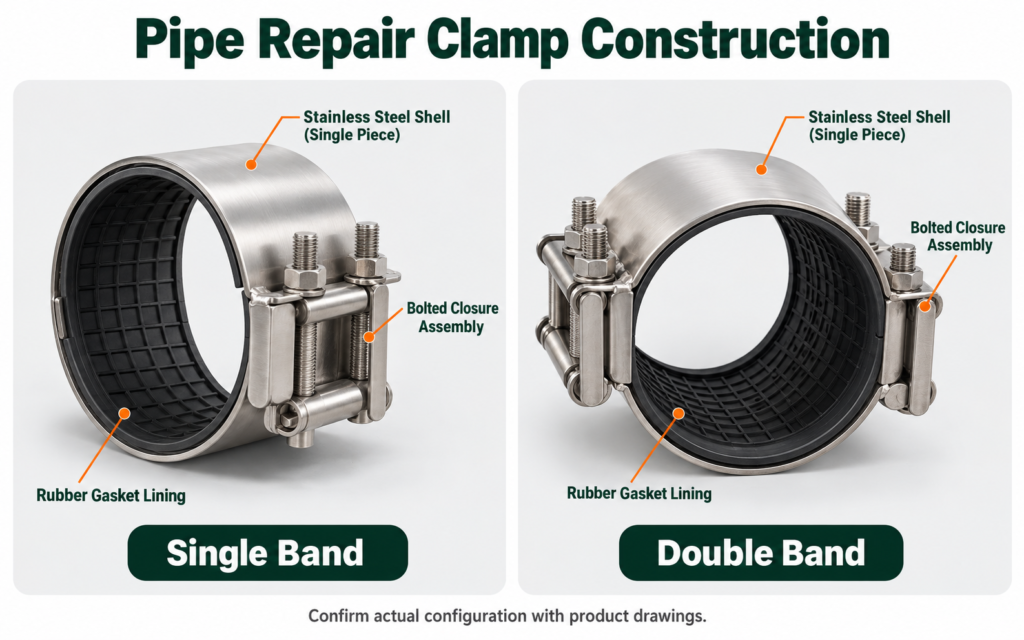
Single band and double band pipe repair clamps can look similar at first glance. Both are used to seal suitable localized leaks on existing pipelines without cutting out the damaged pipe section.
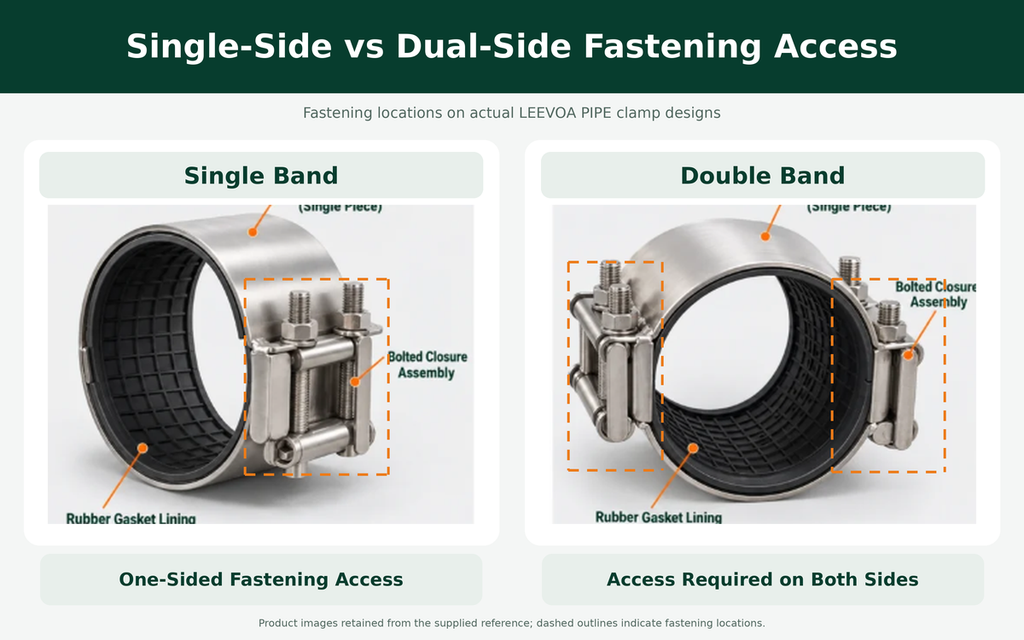
For the LEEVOA PIPE models compared here, both clamps use a one-piece stainless steel wraparound shell and an internal rubber sealing gasket. The main difference is the fastening arrangement: the single band clamp has a bolted closure assembly on one side, while the double band clamp has fastening assemblies on two opposite sides.
That difference affects installation access and fastening procedures, but it does not automatically determine which clamp is stronger or suitable for a particular pipe diameter.
This guide explains the construction, selection criteria and practical applications of both designs.
What Do Single Band and Double Band Mean?
Single Band Pipe Repair Clamp
A single band pipe repair clamp uses one formed stainless steel shell wrapped around the pipe, with a rubber gasket inside and a bolted fastening assembly positioned on one side.
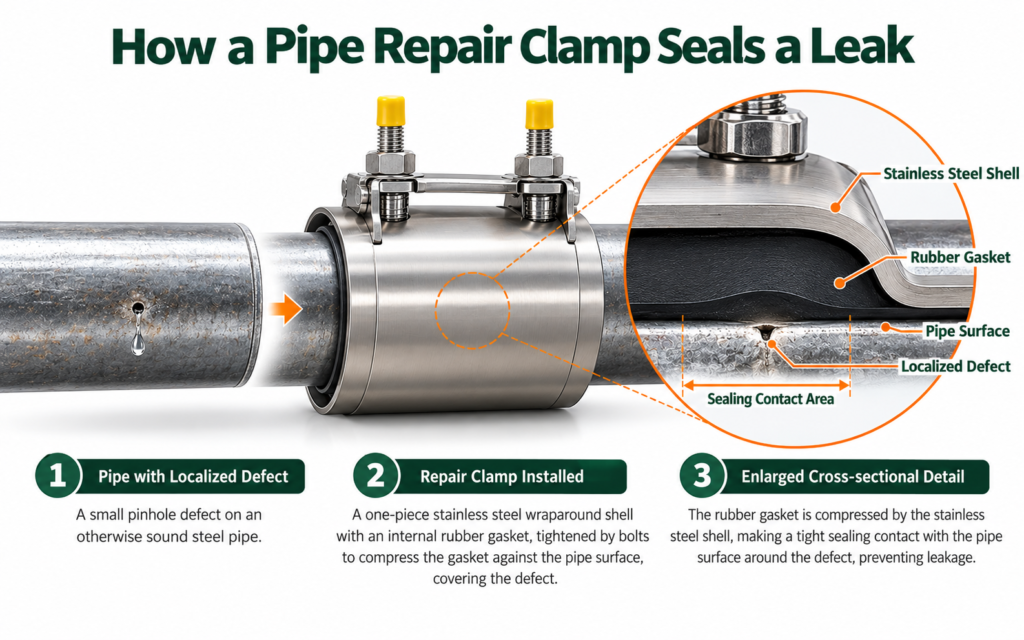
When the fasteners are tightened according to the manufacturer’s instructions, the shell compresses the gasket against the pipe surface, helping seal a compatible localized defect.
The number of individual bolts varies by model. Single band does not mean single bolt.
Double Band Pipe Repair Clamp
The LEEVOA PIPE double band pipe repair clamp also uses one continuous stainless steel shell and an internal rubber gasket.
Its distinguishing feature is the fastening arrangement: bolted assemblies are positioned on two opposite sides of the clamp.
Double band does not mean two separate stainless steel shell halves in this particular design. A two-section or double-plate repair clamp is a different construction.
The term “double band” is not used consistently by every manufacturer. Some suppliers apply it to multi-section clamps. Always compare actual product photographs and approved technical drawings rather than relying on the product name alone.
Single Band vs Double Band: Quick Comparison
The following table compares the two LEEVOA PIPE configurations, not every product sold under these names.
| Comparison Point | Single Band | Double Band |
|---|---|---|
| Stainless steel shell | One-piece wraparound shell | One-piece wraparound shell |
| Fastening arrangement | Bolted closure on one side | Bolted closures on two opposite sides |
| Rubber sealing gasket | Internal gasket compressed against the pipe | Internal gasket compressed against the pipe |
| Installation access | Access to the single fastening side is required | Access to both fastening sides is required |
| Pipe outside diameter | Must match the approved model’s OD range | Must match the approved model’s OD range |
| Clamp length | Selected according to damage and sealing coverage | Selected according to damage and sealing coverage |
| Working pressure | Depends on the exact approved model and service | Depends on the exact approved model and service |
| Material options | Stainless steel 304/316 and suitable gasket compounds, subject to availability | Stainless steel 304/316 and suitable gasket compounds, subject to availability |
| Main selection consideration | One-sided fastening access and model suitability | Two-sided fastening access and model suitability |
Key takeaway: Both designs can serve similar leak-repair applications when correctly specified. The double band configuration should not be assumed to have twice the sealing performance, a higher pressure rating or a greater diameter capacity.
How Do These Pipe Repair Clamps Seal a Leak?
Both designs rely on the same basic sealing principle.
The stainless steel shell wraps around the damaged pipe, while an elastomer gasket sits between the shell and the pipe surface. Tightening the fastening assemblies compresses the gasket to form a seal around a suitable localized defect.
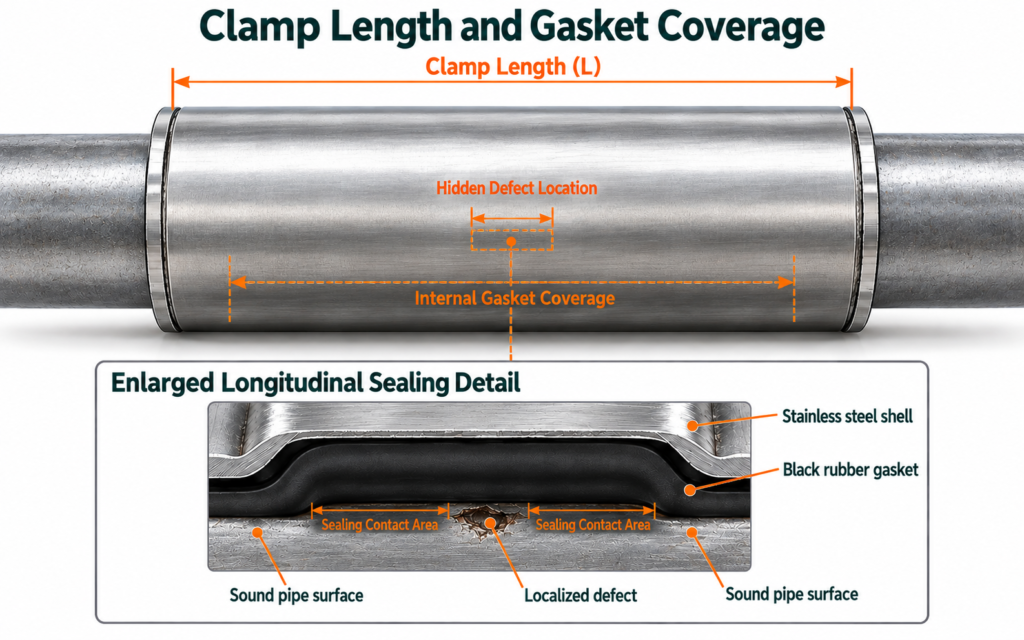
The gasket must extend beyond the damaged area onto sound pipe surface. The available sealing length and gasket construction are therefore just as important as the fastening arrangement.
What Changes During Installation?
For a single band clamp, the installer needs sufficient access to position the shell and tighten the fastening assembly on one side.
For a double band clamp, both fastening sides must be accessible. The installer must follow the specified tightening sequence and torque requirements for the selected model.
Neither design should be tightened using a generic torque value taken from another product. An incorrectly fitted gasket or uneven tightening can compromise sealing performance.
Six Checks Before Choosing a Pipe Repair Clamp
1. Measure the Actual Pipe Outside Diameter
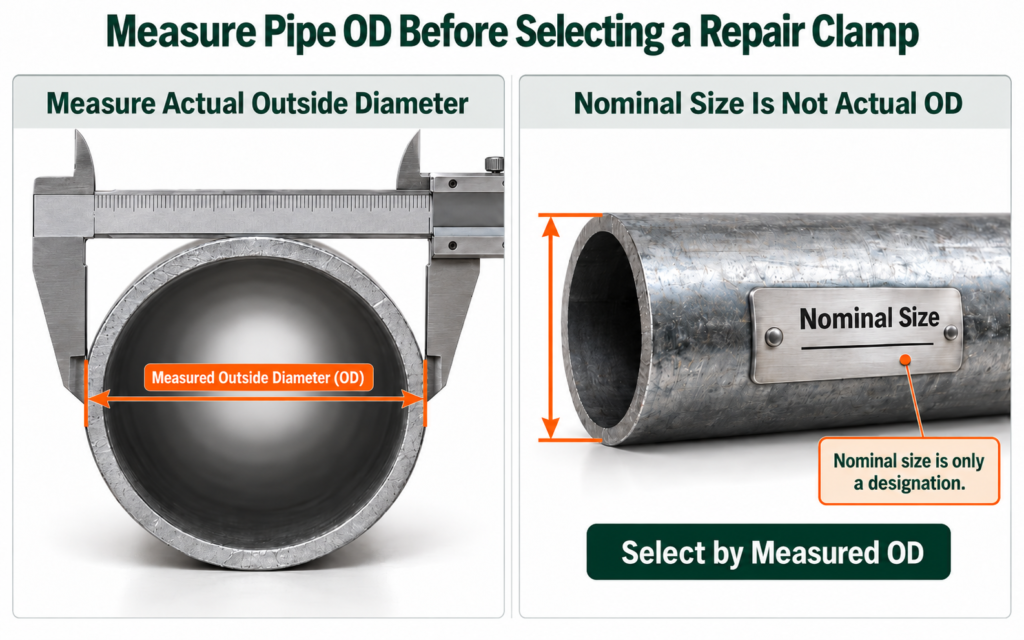
Start with the measured pipe outside diameter (OD), not the nominal pipe size alone.
Two pipes described as DN100 may have different outside diameters depending on their material and manufacturing standard. Check the pipe at the repair location and report any noticeable ovality or surface irregularities.
The selected clamp’s stated OD range must include the actual measured diameter.
2. Identify the Leak and Assess Pipe Condition
Is the problem a pinhole, a short crack, localized corrosion or a larger damaged section?
Measure the damaged area and examine the surrounding pipe surface. A repair clamp needs sufficient sound material to support the seal.
Extensive wall loss, severe deformation or an unstable crack may require pipe replacement or another engineered repair method.
3. Check Clamp Length and Gasket Coverage
Clamp length describes the dimension along the pipe axis. It is not the same as the number of bands or fastening sides.
Choose a length that covers the defect and provides adequate sealing contact on sound pipe surface at both ends.
Do not assume that changing from single band to double band automatically increases repair coverage.
4. Confirm Pressure, Temperature and Fluid
Working pressure, possible pressure surges, operating temperature and the fluid inside the pipe all affect clamp selection.
A double band clamp is not automatically rated for higher pressure. Request the approved working limits for the actual model, pipe OD and application.
5. Select Suitable Stainless Steel and Gasket Materials
Stainless steel 304 is commonly considered for many general-purpose water-piping environments. Stainless steel 316 may be considered where the corrosion exposure calls for it, subject to model availability and project requirements.
EPDM is commonly used for compatible water services. NBR may be suitable for certain oil-containing fluids.
Neither gasket material is universally suitable. Check chemical compatibility, temperature limits and any applicable drinking-water or project approvals.
6. Review Installation Access and Safety
Check the available clearance around the pipe, the position of nearby fittings and the space needed for installation tools.
A single band clamp requires access to its one-sided fastening assembly. A double band clamp requires access to the fastening assemblies on both sides.
Follow the manufacturer-approved installation procedure. Unless an expressly approved procedure permits otherwise, isolate and depressurize the pipeline before repair.
Three Practical Selection Examples
Example 1: A Small Pinhole Leak on a Steel Water Pipe
A steel water pipe has a localized pinhole, the pipe wall remains structurally sound and the measured OD falls within the selected clamp’s approved range.
A single band stainless steel pipe repair clamp may be a practical first option, particularly where access to one fastening side is convenient.
Final suitability still depends on the gasket, clamp length, pressure rating and damage location.
Example 2: A Water Pipeline With Access to Both Sides
A pipeline has a localized leak, and sufficient space is available around both sides of the pipe for the fastening assemblies.
A double band repair clamp may be considered when the approved model fits the measured OD, provides sufficient gasket coverage and meets the service requirements.
The reason for choosing this configuration is its suitability and fastening layout—not an assumed increase in strength.
Example 3: An Older Pipe With Corrosion or an Irregular Surface
An older cast iron or ductile iron pipe has an uneven outside surface and an uncertain outside diameter.
Neither single band nor double band construction should be selected from the nominal size alone.
Measure the pipe, document the corrosion and ask the supplier to review the appropriate OD tolerance, gasket arrangement and remaining structural condition.
If the pipe has lost significant wall strength, a mechanical repair clamp may not be an appropriate solution.
When Is a Pipe Repair Clamp Not Enough?
Stainless steel repair clamps are useful for selected localized leaks, but they are primarily sealing components, not universal structural reinforcement or axial restraint devices.
A different repair approach may be needed when the pipeline has:
- Severe corrosion or extensive wall loss.
- Major deformation or an unstable, growing crack.
- A completely separated pipe section or displaced joint.
- Significant axial movement or unsupported piping.
- Damage extending beyond the available gasket sealing area.
In these cases, a qualified engineer should assess whether a designed repair sleeve, pipe section replacement or another approved method is required.
For broader guidance, see our Emergency Pipe Repair overview.
What to Send for a Technical Quote
When requesting a single band or double band pipe repair clamp, providing accurate operating and dimensional information helps avoid ordering the wrong configuration.
Please include:
- Pipe information: material, nominal size, measured outside diameter and relevant pipe standard.
- Damage details: leak type, dimensions, location and photographs.
- Operating conditions: working pressure, possible surges, fluid and temperature.
- Installation conditions: available clearance, pipe surface condition and any site restrictions.
- Purchasing requirements: quantity, delivery destination and applicable project specifications.
LEEVOA PIPE can review these details against available clamp configurations and approved supplier drawings before preparing a quotation.
Request a Pipe Repair Clamp Quote
Frequently Asked Questions
Is a double band pipe repair clamp made from two stainless steel shells?
Not in the LEEVOA PIPE configuration discussed here. It uses one continuous stainless steel shell with fastening assemblies on two opposite sides. Other manufacturers may use the same name for different constructions.
Does a double band clamp have a higher pressure rating?
Not necessarily. Pressure suitability depends on the exact model, pipe diameter, materials, gasket, damage and operating conditions. The two-sided fastening layout alone does not establish a higher rating.
Does single band mean the clamp has only one bolt?
No. Single band refers to the clamp configuration and its one-sided closure arrangement. The number of bolts depends on the selected model and dimensions.
Can these repair clamps be used on PVC or HDPE pipe?
Only when the specific clamp design is approved for the pipe material, measured OD and operating conditions. Plastic pipes may have additional installation and support requirements.
Can a repair clamp be installed without shutting down the pipeline?
Do not assume that either design is suitable for installation under pressure. Live repair is acceptable only when the exact product and a site-approved procedure expressly permit it. Otherwise, isolate and depressurize the pipeline first.
Which gasket is better, EPDM or NBR?
Neither is better for every service. EPDM is commonly considered for compatible water applications, while NBR may be suitable for certain oil-containing fluids. The actual material must be selected according to the medium, temperature and applicable requirements.
Final Selection Advice
The main difference between the LEEVOA PIPE single band and double band repair clamps is the location of their fastening assemblies, not the number of stainless steel shell sections.
Both use a one-piece wraparound shell and a rubber gasket. The right choice depends on the measured pipe OD, defect size, sealing coverage, pressure requirements, material compatibility and installation access.
Before ordering, compare the actual model drawings and operating limits. A correctly specified clamp is more important than choosing a product name that sounds stronger.
Explore the available models:
For project-specific requirements, contact LEEVOA PIPE with your pipe dimensions, damage photographs and operating data.
Technical note: This comparison describes the specific LEEVOA PIPE configurations linked above. Other manufacturers may classify pipe repair clamps differently, so their drawings and installation instructions must be checked independently.