PRODUCT MODEL
Threaded Union Rubber Expansion Joint
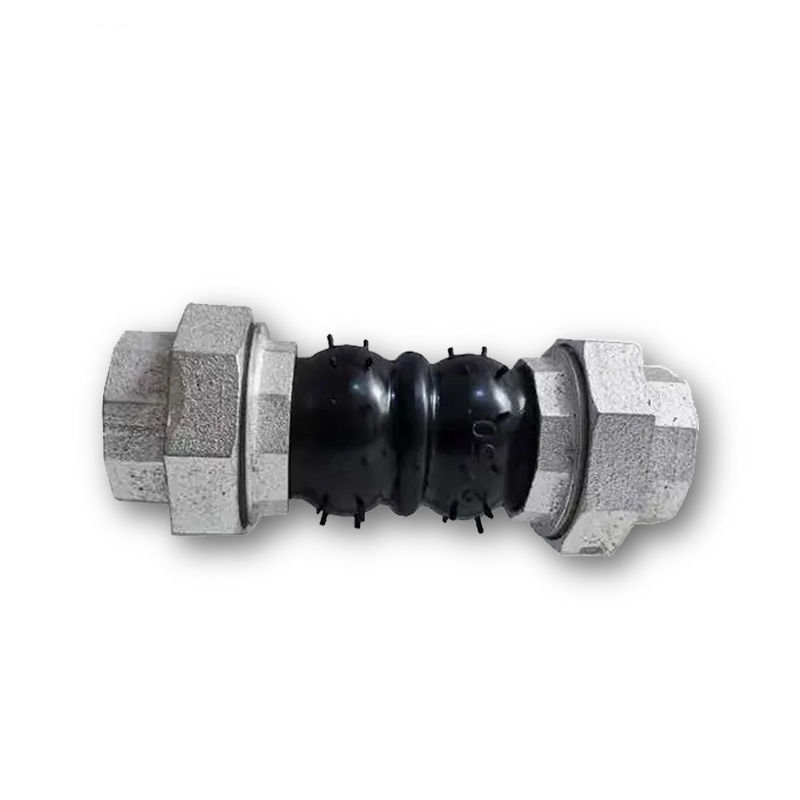
A Threaded Union Rubber Expansion Joint is a flexible pipe connector designed for small-diameter piping systems where threaded connections are preferred over flanges. It combines a reinforced rubber bellows with metal union fittings to help absorb equipment vibration, reduce noise transmission and accommodate limited pipe movement.
LEEVOA PIPE supplies threaded rubber expansion joints for HVAC piping, pump connections, water distribution systems and compatible industrial utility lines. Common industry configurations cover DN15–DN80 (1/2″–3″), with rubber compounds, union materials and thread forms selected according to the installation and operating requirements.
Why Choose a Threaded Union Rubber Expansion Joint?
- Threaded union connection: Eliminates the need for a separate flange pair and flange-bolt assembly in suitable small-bore piping.
- Vibration isolation: Helps reduce vibration transmitted from pumps and mechanical equipment to connected pipework.
- Noise reduction: The flexible rubber body limits the direct transmission of structure-borne vibration and associated noise.
- Movement accommodation: Allows specified axial, lateral and angular displacement within the approved movement limits.
- Serviceable connection: Union fittings allow the joint to be disconnected for maintenance without cutting or welding the adjoining pipe.
Threaded Union Rubber Expansion Joint Construction
A typical threaded union rubber expansion joint consists of a reinforced elastomeric body fitted with metal unions at both ends. Many common designs use two rubber arches, although body geometry and connection details vary by model.
The main components include:
- Inner rubber liner: Provides the wetted surface in contact with the process medium.
- Reinforcing fabric: Synthetic cord layers help the rubber body withstand its specified operating conditions.
- Outer rubber cover: Protects the reinforcing layers from environmental exposure within the material’s limitations.
- Rubber bellows: Provides flexibility for vibration isolation and controlled movement.
- Metal union assemblies: Connect the joint to compatible threaded pipe ends and allow disassembly.
The number of rubber arches and the reinforcement arrangement must be confirmed against the selected product drawing.
Technical Specifications
| Specification | Reference Configuration / Selection |
|---|---|
| Product Name | Threaded Union Rubber Expansion Joint |
| Alternative Names | Threaded Rubber Expansion Joint; Union Type Rubber Expansion Joint; Screwed Rubber Connector |
| Reference Size Range | DN15–DN80 (1/2″–3″) |
| Body Construction | Reinforced rubber bellows; twin-arch designs commonly used |
| End Connection | Threaded metal unions |
| Thread Options | BSPP, BSPT, NPT; subject to confirmation |
| Rubber Options | EPDM, NBR, NR, CR / Neoprene |
| Reinforcement | Synthetic cord fabric; additional reinforcement depends on design |
| Union Materials | Malleable iron commonly used; other materials subject to confirmation |
| Pressure Selection | PN10 / PN16 commonly requested; actual rating is model-dependent |
| Operating Temperature | Depends on rubber compound, medium, pressure and construction |
| Movement | Axial compression, extension, lateral displacement and angular deflection |
| Installation Length | Model- and size-dependent; confirm approved drawing |
| Vacuum Service | Requires specific vacuum capability verification |
| Custom Requirements | Thread form, rubber material, union material and selected dimensions |
Technical note: A nominal PN16 designation does not automatically establish a 16 bar allowable working pressure at every temperature or under every operating condition. The complete joint rating, connection compatibility and movement capacity must be checked before selection.
Available Nominal Sizes
The following are common nominal sizes for threaded rubber expansion joints. They identify the nominal pipe connection size, not a measured outside diameter or a guaranteed installation length.
| Nominal Diameter | Nominal Size |
|---|---|
| DN15 | 1/2″ |
| DN20 | 3/4″ |
| DN25 | 1″ |
| DN32 | 1 1/4″ |
| DN40 | 1 1/2″ |
| DN50 | 2″ |
| DN65 | 2 1/2″ |
| DN80 | 3″ |
Reference catalog lengths vary between manufacturers and models. The face-to-face dimension, end configuration and movement allowance should be confirmed from the approved drawing rather than inferred from nominal size alone.
Thread Connection Options: BSPP, BSPT and NPT
The thread standard is one of the most important details when selecting a screwed rubber expansion joint. Threaded connections that appear similar may have different thread profiles, taper arrangements and sealing methods.
| Thread Type | Selection Consideration |
|---|---|
| BSPP | Parallel pipe thread; sealing arrangement must be compatible with the mating fitting |
| BSPT | Tapered pipe-thread system; requires the correct mating thread and sealing method |
| NPT | Tapered pipe-thread system commonly used in North American applications |
BSPP, BSPT and NPT must not be treated as automatically interchangeable. Specify the required thread type, nominal size, connection gender and sealing arrangement when requesting a quotation.
Rubber Material Options
Selecting the correct rubber compound is essential for reliable service.
| Rubber Material | Typical Application Considerations |
|---|---|
| EPDM | Compatible hot and cold water, HVAC and selected outdoor applications; generally unsuitable for petroleum oils |
| NBR / Nitrile | Applications involving compatible oils, lubricants or hydrocarbon-containing fluids |
| NR / Natural Rubber | Selected general water or utility services where natural rubber is chemically suitable |
| CR / Neoprene | Selected water, weather-exposure and moderate oil-resistance requirements |
Rubber compatibility must be checked against the specific medium, concentration, continuous operating temperature and pressure. Special services, including potable water, fire protection, steam or aggressive chemical systems, require separate suitability and approval checks.
Movement and Vibration Control
A threaded rubber flexible joint can accommodate several forms of movement when the selected model is designed for them.
- Axial compression: Shortening along the pipe centerline.
- Axial extension: Lengthening along the pipe centerline.
- Lateral displacement: Sideways movement between the connected pipe ends.
- Angular deflection: A limited angular difference between the connected pipe centerlines.
Allowable movement values depend on the joint geometry and operating conditions. Maximum values for separate movement directions should not be added together without engineering verification.
The joint must not be twisted during installation or used to compensate for major pipe misalignment. It is not a substitute for proper pipe supports, anchors or pressure-thrust restraint.
Typical Applications
HVAC and Building Services
Threaded union rubber expansion joints are suitable for consideration in compatible chilled-water, heating-water and mechanical service piping where a small-diameter flexible connection is required.
Pump and Mechanical Equipment Connections
The reinforced rubber body can help reduce vibration transfer between pumps and adjoining pipework. Piping supports, pressure thrust and pump nozzle loads must be checked before installation.
Water Supply and Treatment Equipment
Threaded rubber joints may be used in compatible water supply, filtration and treatment equipment connections, subject to material and operating-condition verification.
Industrial Utility Piping
Compressed-air auxiliaries, process-water lines and other small-diameter utility connections may benefit from a flexible connector where the medium and service conditions are suitable.
Threaded Union vs Flanged Rubber Expansion Joint
| Feature | Threaded Union Type | Flanged Type |
|---|---|---|
| Connection | Screwed union fittings | Bolted pipe flanges |
| Typical Size Application | Small-diameter piping | Small to large piping, depending on design |
| Connection Hardware | No separate flange-bolt set | Flange bolts and nuts |
| Maintenance | Union disassembly | Flange-bolt removal |
| Selection Priority | Thread compatibility and union geometry | Flange drilling, facing and bolt arrangement |
Threaded and flanged designs are not universally interchangeable. The correct choice depends on pipe connection requirements, nominal diameter, operating conditions, movement requirements and available installation space.
For flanged alternatives, see the Single Sphere Rubber Expansion Joint or explore the Rubber Expansion Joint product range.
Installation and Maintenance Considerations
- Verify thread compatibility. Confirm size, thread standard, connection gender and sealing method before installation.
- Support the adjoining piping. The rubber joint must not carry unsupported pipe weight or act as a structural anchor.
- Prevent twisting. Use appropriate tools on the metal fittings and follow the approved tightening procedure without applying excessive torsion to the rubber body.
- Maintain the approved installation length. Do not forcibly stretch or compress the joint to make up a dimensional error.
- Review pressure thrust and vacuum. Positive-pressure thrust, transient pressure and suction-side vacuum conditions may require additional engineering measures or a different joint design.
- Inspect after commissioning. Check for leakage, abnormal deformation, loose connections and deterioration during planned maintenance.
For related system-design considerations, see Pipe Vibration & Movement Control.
How to Specify a Threaded Union Rubber Expansion Joint
When requesting a quotation, provide the nominal pipe size, BSPP/BSPT/NPT thread requirement, connection gender, working medium, temperature and pressure.
Also include the available installation length, expected movement, piping support arrangement and required quantity. If replacing an existing connector, photographs and a dimensional drawing can help verify the connection.
Frequently Asked Questions
What is a threaded union rubber expansion joint used for?
It provides a flexible connection in small-diameter threaded piping, helping reduce vibration and noise while accommodating limited movement within the joint’s approved capacity.
What sizes are commonly available?
Common industry configurations cover DN15–DN80 (1/2″–3″). Actual LEEVOA availability, dimensions and connection details must be confirmed for the selected model.
Are BSP and NPT threaded rubber joints interchangeable?
No. BSPP, BSPT and NPT have different thread and sealing characteristics. The joint must be matched to the specified mating pipe connection.
Can a threaded rubber expansion joint be used for hot water or oil?
It may be suitable when the selected elastomer, union materials and complete joint rating match the medium and operating conditions. EPDM is commonly considered for compatible hot-water service, while NBR is often considered for compatible oil-containing media.
Can a threaded rubber expansion joint correct pipe misalignment?
Only limited displacement within the approved joint movement range can be accommodated. It should not be used to pull severely misaligned pipe ends together or replace proper pipeline alignment.
Can it be installed on a pump suction line?
Only after the suction pressure, possible vacuum, pipe support and joint design have been reviewed. A standard threaded rubber connector must not be assumed suitable for vacuum service without confirmation.
Request a Quote for Threaded Union Rubber Expansion Joints
LEEVOA PIPE can review your small-diameter piping requirements and help identify an appropriate threaded rubber joint configuration.
Send your pipe size, thread standard, medium, pressure, temperature, installation length and quantity to sales@leevoapipe.com, or submit your requirements through our Request a Quote page.