PRODUCT MODEL
PTFE-Lined Rubber Expansion Joint
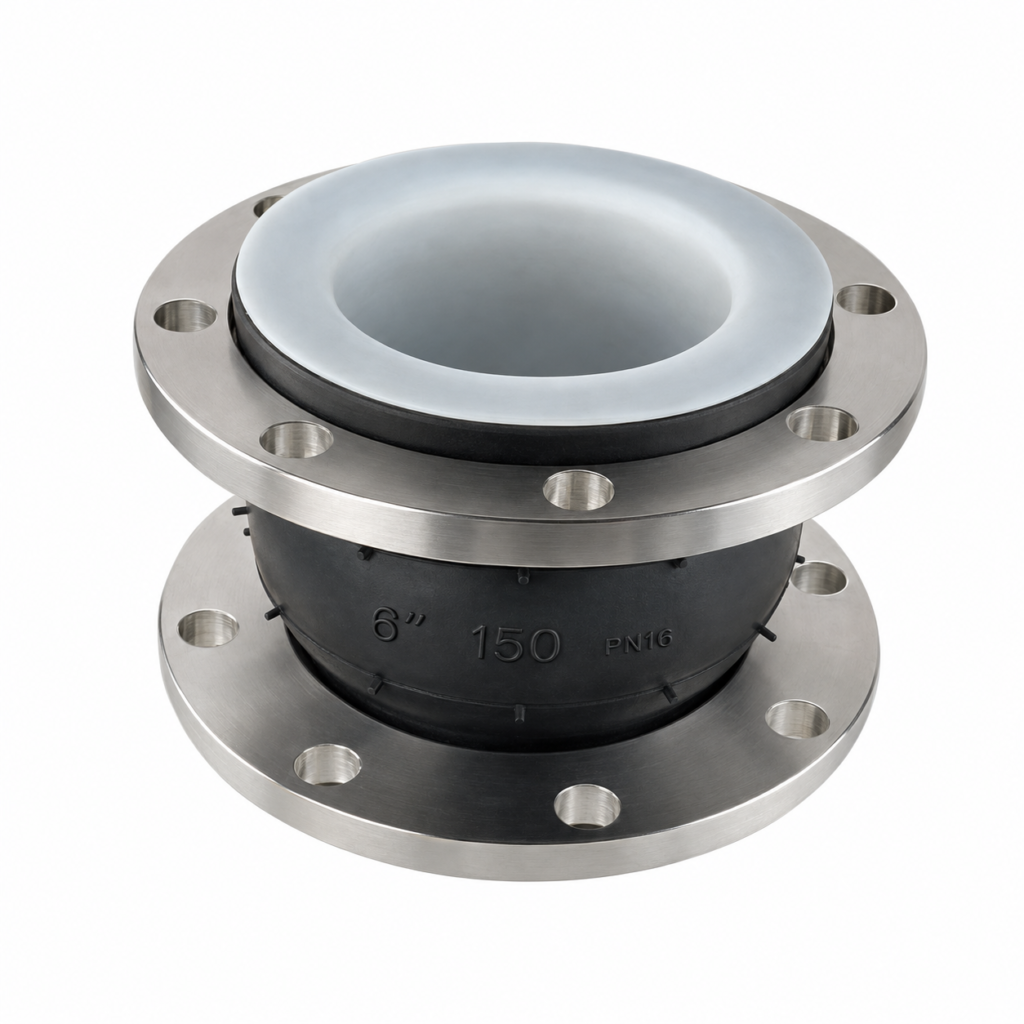
A PTFE-Lined Rubber Expansion Joint combines a chemical-resistant PTFE inner liner with a reinforced rubber body to provide a flexible connection for industrial piping. It is commonly considered for systems carrying compatible corrosive chemicals, acids, alkaline solutions and industrial process liquids where direct contact with a conventional rubber lining may not be suitable.
LEEVOA PIPE supplies PTFE-lined rubber expansion joints in single sphere and double sphere configurations. The appropriate design depends on the working medium, temperature, pressure, required movement, flange connection and installation conditions.
Why Use a PTFE-Lined Rubber Expansion Joint?
A conventional rubber expansion joint relies on its inner elastomer surface to resist the conveyed fluid. In chemical service, the rubber compound may not provide the required resistance to a particular medium or concentration.
A PTFE-lined design introduces a separate chemical-resistant surface between the process fluid and the reinforced rubber body. This helps broaden the range of potential applications while retaining the mechanical functions of a flexible rubber connector.
Key considerations include:
- Chemical-resistant contact surface: PTFE provides resistance to many industrial chemicals when the complete joint is suitable for the specific medium and operating conditions.
- Flexible connection: The reinforced rubber body helps accommodate approved pipeline movement and equipment vibration.
- Reduced fluid exposure to rubber: A continuous, correctly constructed PTFE liner separates the process fluid from the underlying elastomer.
- Flanged installation: Different flange materials and drilling arrangements can be selected to match project requirements.
- Application-specific configurations: Single sphere and double sphere designs allow the joint geometry to be selected according to the piping arrangement.
The PTFE liner does not automatically make the entire assembly suitable for every chemical, temperature, pressure or vacuum condition. The complete joint must be evaluated before selection.
PTFE-Lined Rubber Expansion Joint Construction
A typical PTFE-lined rubber joint consists of a chemically resistant internal liner, reinforced elastomeric body and metal flange connections.
Main Components
- PTFE Inner Liner: Forms the primary contact surface for the conveyed fluid. Its continuity, thickness, attachment and termination at the sealing faces depend on the selected construction.
- Reinforced Rubber Body: Provides the flexible joint geometry. EPDM or NBR compounds may be used according to the approved design and service requirements.
- Fabric Reinforcement: Reinforcing textile layers help support the rubber body under the specified operating conditions.
- Outer Rubber Cover: Protects the reinforced body from external exposure within the limitations of the selected rubber compound.
- Metal Flanges: Connect the expansion joint to the adjoining piping. Carbon steel and stainless steel options can be reviewed according to the installation environment.
- Optional Restraint or Vacuum Support Components: Control rods, limit rods or internal support components may be necessary for particular designs and piping conditions.
The PTFE liner must remain suitable for the intended movement and pressure conditions. Its construction should be checked against the approved manufacturer drawing rather than judged only from the external appearance.
Technical Specifications
| Specification | Available Configuration / Selection Guidance |
|---|---|
| Product Name | PTFE-Lined Rubber Expansion Joint |
| Alternative Names | PTFE Lined Rubber Joint; Chemical Resistant Rubber Expansion Joint; PTFE Lined Flexible Connector |
| Body Configuration | Single sphere or double sphere reinforced rubber body |
| Internal Lining | PTFE; liner construction and coverage subject to approved design |
| Rubber Body | EPDM or NBR, depending on configuration |
| Reinforcement | Synthetic fabric reinforcement; construction-dependent end reinforcement |
| Flange Materials | Carbon steel, SS304 or SS316, subject to configuration |
| Flange Drilling | EN / DIN, ANSI / ASME or JIS options subject to confirmation |
| Nominal Diameter | Model-dependent; confirm the available DN / NPS range |
| Working Pressure | Size-, temperature- and design-dependent |
| Operating Temperature | Determined by the complete joint assembly and conveyed medium |
| Movement Capability | Axial, lateral or angular movement only within the approved model limits |
| Vacuum Service | Requires a confirmed vacuum rating and any necessary support arrangement |
| Control / Limit Rods | Evaluated according to pressure thrust, restraint and installation conditions |
| Installation Length | Confirm the required face-to-face dimension and approved drawing |
Technical note: Published ratings for another manufacturer’s PTFE-lined joint should not be treated as universal specifications. A flange designation such as PN16 or ASME Class 150 does not by itself establish the allowable working pressure of the complete rubber expansion joint.
Single Sphere vs Double Sphere PTFE-Lined Expansion Joints
PTFE lining describes the fluid-contact material, while single sphere and double sphere describe the flexible body geometry. Both configurations can incorporate a PTFE liner.
| Feature | PTFE-Lined Single Sphere | PTFE-Lined Double Sphere |
|---|---|---|
| Rubber Body | One flexible arch | Two flexible arches |
| General Geometry | More compact | Generally longer |
| PTFE Contact Surface | Yes | Yes |
| Movement Capability | Depends on approved design | Depends on approved design |
| Selection Priority | Compact installation and required service conditions | Different installation geometry or movement requirements |
| Engineering Review | Chemical compatibility, liner integrity, pressure and movement | Chemical compatibility, liner integrity, pressure and movement |
A double sphere joint may offer greater movement capability in some designs, but this cannot be assumed for every PTFE-lined product. Some liner constructions impose stricter movement limitations than comparable unlined rubber joints.
For conventional configurations, see our Single Sphere Rubber Expansion Joint and Double Sphere Rubber Expansion Joint product pages.
Chemical Resistance and Material Selection
PTFE is valued for its resistance to a wide range of chemicals. However, chemical compatibility is not determined by the PTFE material name alone.
The complete expansion joint must be checked for the actual fluid composition, concentration, temperature, pressure and service duration. Liner construction, end sealing, permeation behavior and the compatibility of any exposed non-PTFE components can also affect suitability.
Acids and Alkaline Solutions
PTFE-lined joints may be considered for pipelines transporting compatible acidic or alkaline process liquids. The exact chemical, concentration and operating temperature must be provided before a material recommendation is made.
Industrial Chemical Solutions
Chemical manufacturing and processing facilities may require a flexible connection where the working medium is unsuitable for direct contact with a standard rubber lining.
Corrosive Industrial Wastewater
Certain wastewater treatment and chemical dosing systems handle liquids that require additional corrosion-resistance measures. A PTFE-lined flexible joint may be considered after reviewing the fluid composition and operating conditions.
When Is PTFE Lining Unnecessary?
For compatible water, HVAC or general utility service, a properly selected conventional rubber expansion joint may be sufficient.
PTFE lining should be chosen because the service conditions justify it, not simply because the material offers broad chemical resistance.
Typical Applications
Chemical Processing Plants
PTFE-lined rubber expansion joints can be considered for compatible chemical transfer and process piping where a corrosion-resistant wetted surface and a flexible connection are both required.
Pulp and Paper Processing
Some pulp and paper processes involve chemically aggressive liquids. PTFE-lined joints may be evaluated for suitable process lines, including selected alkaline and chemical treatment services.
Industrial Wastewater Treatment
Chemical dosing systems and certain industrial wastewater lines may require a PTFE contact surface where the conveyed liquid is unsuitable for ordinary rubber.
Industrial Pump Connections
In compatible chemical-handling systems, a PTFE-lined joint may help isolate equipment vibration. Pump nozzle loads, pressure thrust, suction conditions and the movement limitations of the selected joint must be reviewed.
Explore our Industrial Piping Systems and Pump & Mechanical Connections application pages for related piping considerations.
PTFE-Lined vs Conventional Rubber Expansion Joint
| Selection Factor | Conventional Rubber Joint | PTFE-Lined Rubber Joint |
|---|---|---|
| Fluid-Contact Surface | Selected rubber compound | PTFE liner |
| Chemical Compatibility | Depends on rubber compound | Depends on PTFE liner and complete assembly |
| Primary Selection Consideration | Suitable elastomer, movement and operating conditions | Chemical exposure, liner construction and operating conditions |
| Flexible Body | Reinforced rubber | Reinforced rubber with PTFE liner |
| Movement Rating | Model-specific | Model-specific; liner may introduce restrictions |
| Typical Applications | Compatible water, HVAC and general industrial services | Compatible corrosive chemical and industrial process services |
The correct choice depends on the actual medium and piping design. Neither construction should be selected based only on a general corrosion-resistance claim.
Important Selection and Installation Considerations
Verify Chemical Compatibility
Provide the chemical name, concentration, normal operating temperature and maximum expected temperature. Mixed chemicals and cleaning agents must also be considered.
Check Pressure and Vacuum Conditions
Confirm normal working pressure, possible pressure surges and any negative-pressure conditions. A vacuum support ring shown in a reference design does not automatically mean every PTFE-lined model is suitable for vacuum service.
Confirm Movement Requirements
Specify the expected axial compression, extension, lateral movement and angular deflection. Published movement limits are model-specific and should not be combined without engineering approval.
Review Pipe Anchors and Restraints
Internal pressure generates thrust forces. The piping system must have an appropriate anchor, guide and support arrangement. Control rods or limit rods may be needed depending on the installation.
Protect the PTFE Sealing Surface
Inspect the liner and sealing faces before installation. Avoid scratches, pinching, twisting or other damage to the PTFE. Follow the approved installation instructions and flange tightening procedure.
Confirm the Approved Drawing
Verify the face-to-face length, flange drilling, liner termination, support components and installation clearances before ordering or replacing an existing joint.
How to Specify a PTFE-Lined Rubber Expansion Joint
For technical review and quotation, please provide:
- Nominal size: Required DN or NPS.
- Working medium: Chemical name, composition and concentration.
- Temperature: Normal, maximum and cleaning-cycle temperatures.
- Pressure: Operating pressure, surge conditions and any vacuum requirement.
- Preferred configuration: Single sphere, double sphere or an existing replacement design.
- Flange requirements: Drilling standard, flange material and connection dimensions.
- Installation length: Required face-to-face dimension.
- Movement and restraint: Expected movement, pipe support arrangement and any control-rod requirements.
- Project details: Quantity, destination, drawings and required documentation.
If an existing expansion joint is being replaced, a clear photograph, dimensional drawing and operating conditions can help identify an appropriate configuration.
Frequently Asked Questions
What is a PTFE-lined rubber expansion joint?
It is a flexible reinforced rubber connector with a PTFE internal contact surface. The PTFE liner is intended for compatible chemical service, while the rubber body provides flexibility within the selected joint’s approved operating limits.
Is a PTFE-lined rubber expansion joint the same as a PTFE bellows expansion joint?
No. A PTFE-lined rubber expansion joint uses a reinforced rubber body with a PTFE inner liner. A PTFE bellows expansion joint may use a PTFE bellows as its principal flexible element. Their construction and operating limits can differ.
Can PTFE-lined rubber expansion joints handle acids and alkalis?
They may be suitable for many compatible acidic and alkaline solutions, but not every chemical mixture or operating condition. Chemical concentration, temperature, pressure and complete assembly construction must be reviewed.
Are single sphere and double sphere PTFE-lined joints available?
Yes. PTFE-lined configurations can use single sphere or double sphere rubber bodies. The appropriate model depends on the required dimensions, chemical service and approved movement limits.
Can a PTFE-lined rubber joint be used under vacuum?
Only when the selected model is specifically approved for the required negative pressure. Some designs are not suitable for vacuum service, while others may require dedicated internal support components.
Does PTFE lining improve the pressure rating?
Not necessarily. PTFE primarily provides a chemically resistant contact surface. The allowable working pressure depends on the entire expansion joint construction, size, operating temperature and approved manufacturer rating.
Request a Quote for PTFE-Lined Rubber Expansion Joints
LEEVOA PIPE supplies PTFE-lined rubber expansion joints for industrial piping applications that require a compatible chemical-resistant contact surface and a flexible connection.
Send us your working medium, chemical concentration, temperature, pressure, nominal diameter, flange standard and installation requirements. We can review the suitable configuration and prepare a quotation based on your project conditions.
Submit Your Piping Requirements
Email: sales@leevoapipe.com
WhatsApp: +86 156 3813 8723