PRODUCT MODEL
Double Sphere Rubber Expansion Joint
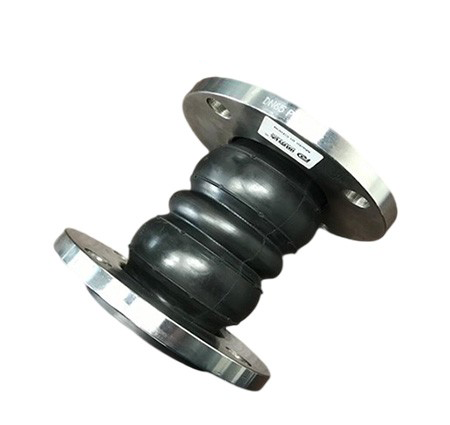
LEEVOA PIPE supplies double sphere rubber expansion joints for flanged piping systems that require greater movement capacity and flexible connections. Also known as twin sphere rubber expansion joints or double arch rubber expansion joints, these joints use two reinforced rubber arches to accommodate axial, lateral and angular movement while helping reduce the transmission of vibration and noise.
Compared with a similar single sphere design, the double sphere configuration generally offers more movement flexibility, although it requires additional installation space. It is suitable for selected pump connections, water and wastewater systems, HVAC equipment and industrial piping where operating conditions and movement requirements have been reviewed.
Rubber compounds, flange materials, pressure classes and control rod configurations can be selected according to the project. Final dimensions, movement ratings and operating limits must be confirmed for the specified joint before ordering.
Why Choose a Double Sphere Rubber Expansion Joint?
A double sphere joint is worth considering when the expected pipeline movement is beyond the approved capacity of a comparable single sphere joint, or when the connection requires additional flexibility.
Greater Movement Accommodation
Two flexible arches allow the rubber body to deform over a longer flexible section. This can provide greater axial compression, axial extension and lateral movement capacity than a comparable single arch construction. Actual movement ratings depend on the nominal diameter, rubber reinforcement, joint geometry and operating conditions.
Vibration and Noise Isolation
The reinforced elastomer body provides a flexible interface between connected pipe sections or equipment. It can help limit the transfer of mechanical vibration and structure-borne noise, particularly around pumps and other rotating equipment. The result depends on the joint selection, piping supports and equipment arrangement.
Flexibility for Thermal Movement
Temperature changes can cause piping to expand or contract. A correctly selected double sphere rubber expansion joint can accommodate specified movement within its approved limits, helping manage movement at the connection without treating the joint as a substitute for proper pipe supports and anchors.
Multiple Material and Flange Options
EPDM, NBR and other suitable rubber compounds, together with carbon steel or stainless steel flange options, allow the joint configuration to be matched to different media and installation requirements.
Double Sphere Rubber Expansion Joint Construction
A typical flanged double sphere joint consists of two flexible rubber arches within a reinforced elastomer body. The body connects to metal flanges at both ends, with reinforcement elements selected according to the joint design.
Main Components
- Inner Rubber Layer: The surface in contact with the flowing medium. Its compound must be compatible with the fluid and operating temperature.
- Outer Rubber Cover: Protects the reinforcement from environmental exposure under the specified service conditions.
- Reinforcing Fabric: Multiple layers of cord fabric provide strength while allowing controlled flexibility.
- Steel Reinforcement: Reinforcing rings or wire elements support the rubber-and-flange interface according to the joint design.
- Double Arch Body: Two flexible bulged sections connected by a central waist provide the twin sphere configuration.
- Metal Flanges: Connect the joint to the mating pipe flanges. Material and drilling are selected to match the project.
- Optional Control Units: Limit rods or control assemblies may be specified where movement restraint is required.
The exact construction, reinforcement arrangement and flange interface must follow the approved product drawing.
Double Sphere Rubber Expansion Joint Technical Specifications
| Specification | Available Configuration / Requirement |
|---|---|
| Product Type | Double Sphere / Twin Sphere Rubber Expansion Joint |
| Connection Type | Flanged connection |
| Rubber Body | Two reinforced flexible rubber arches |
| Rubber Materials | EPDM, NBR, NR, CR / Neoprene; other compounds subject to review |
| Reinforcement | Reinforcing cord fabric and steel reinforcement, according to design |
| Flange Materials | Carbon steel, galvanized carbon steel, ductile iron, SS304 or SS316, depending on configuration |
| Flange Standards | DIN / EN, ANSI / ASME, JIS or project-specific drilling |
| Nominal Size | DN / NPS to be confirmed for the selected double sphere design |
| Pressure Class | Common PN10 / PN16 configurations; PN25 and other requirements subject to technical confirmation |
| Operating Temperature | Depends on rubber compound, pressure, medium and joint construction |
| Movement Types | Axial compression, axial extension, lateral and angular movement |
| Face-to-Face Length | According to nominal size and approved configuration |
| Control Rods | Available for selected designs where required |
| Custom Requirements | Selected flange drilling, rubber compound and project-specific dimensions |
Technical Note: These are configuration options, not one universal rating for every size. Pressure, temperature, movement and dimensions must be verified together. A higher flange pressure class does not automatically establish the working pressure rating of the complete rubber joint.
Dimensions and Face-to-Face Length
Face-to-face length is the distance between the two connection faces of the rubber expansion joint at its specified installation position. A double sphere joint generally needs more installation space than a corresponding single sphere joint because it has two flexible arches.
Before selecting a joint, confirm the nominal pipe size, available installation gap, mating flange dimensions and required movement. Standard lengths vary between product designs, and a dimension listed for one manufacturer’s joint should not be treated as interchangeable with another.
Dimensions to Confirm Before Ordering
| Dimension / Parameter | Why It Matters |
|---|---|
| DN / NPS | Matches the nominal piping connection. |
| Face-to-Face Length (L) | Determines the required installation space between mating flanges. |
| Flange Outside Diameter | Helps verify the flange envelope and available clearance. |
| Bolt Circle and Hole Pattern | Ensures the joint flange drilling matches the mating flanges. |
| Movement Allowance | Confirms that expected displacement is within approved limits. |
| Control Rod Arrangement | Provides installation and clearance information where movement restraints are required. |
For projects requiring a dimensional schedule, contact LEEVOA PIPE with the DN, pressure class and flange standard. We can review the applicable drawing and dimensions for the requested configuration.
Rubber Materials for Different Operating Media
Rubber selection is based on the actual fluid, operating temperature, pressure and environmental exposure. Different compounds cannot be treated as interchangeable simply because the expansion joints have the same dimensions.
EPDM Rubber
EPDM is commonly considered for water, hot water and compatible general utility services. It provides useful weathering and ozone resistance but is generally unsuitable for petroleum oils and many hydrocarbon fluids.
NBR / Nitrile Rubber
NBR is commonly selected when resistance to petroleum-based oils or compatible hydrocarbon fluids is important. The specific fluid composition and operating conditions must still be checked.
CR / Neoprene Rubber
Neoprene provides an alternative balance of weathering resistance, mechanical properties and resistance to certain oils. Suitability depends on the actual service conditions.
NR / Natural Rubber
Natural rubber can be used for selected compatible general-service applications where flexibility and mechanical resilience are required. Chemical and temperature suitability must be verified.
Other elastomers may be considered for special duties after a compatibility review. Do not assume that an ordinary rubber joint is suitable for steam, concentrated chemicals, drinking-water contact or full-vacuum service without the appropriate product rating and required approvals.
How Much Movement Can a Double Sphere Rubber Expansion Joint Absorb?
A double sphere joint is designed to accommodate defined movements within its rated capability. The allowable movement is not a single universal value, and two arches do not automatically mean exactly twice the movement of every single sphere joint.
Axial Compression
Movement that shortens the joint along the pipe centerline. It can occur when the connected pipework moves toward the joint.
Axial Extension
Movement that increases the distance between the joint connection faces. Excessive extension must be prevented by an appropriate piping design and, where specified, control units.
Lateral Movement
Sideways displacement between the joint ends while the connection axes remain approximately parallel. The allowable offset must be confirmed from the selected design.
Angular Movement
Relative angular rotation between the joint ends. The permitted angle depends on the construction and the other movements occurring at the same time.
Engineering Consideration: Published maximum values for compression, extension, lateral offset and angular movement should not be added together or assumed to be available simultaneously. Combined movements, pressure, temperature and installation conditions may reduce the permissible operating envelope.
Applications of Double Sphere Rubber Expansion Joints
Pumps and Mechanical Equipment
A double sphere rubber connector can provide a flexible connection in suitable pump suction or discharge piping. It may help isolate vibration and accommodate specified movement, but the pump nozzles and piping must remain properly supported. See our Pump & Mechanical Connections application page.
Water and Wastewater Systems
Double sphere joints may be used in water-treatment facilities, pumping stations and wastewater systems where the selected rubber and flange materials are compatible with the medium. Application-specific approvals must be confirmed where required. Explore Water & Wastewater Systems.
HVAC and Building Services
Flexible flanged connections can help manage vibration transfer and specified movement in compatible chilled-water, heating-water and mechanical piping systems. Temperature and pressure requirements must be checked for the selected rubber compound.
Industrial Piping
Industrial utility and process lines may need flexible connections where movement or equipment vibration is expected. Material compatibility, installation layout and operating loads should be reviewed before selection. Learn more about Industrial Piping Systems.
Installation, Anchoring and Control Rod Considerations
A rubber expansion joint must be installed as part of a properly designed piping system. It should not be used to pull significantly misaligned flanges into position or compensate for inadequate pipe supports.
- Verify the installed face-to-face length against the approved drawing.
- Check flange alignment, mating surfaces and applicable bolting instructions.
- Provide appropriate pipe supports, anchors and guides for the system.
- Account for pressure thrust and equipment nozzle loads.
- Use control rods or limit units where required by the piping design.
- Protect the rubber body from incompatible chemicals, excessive heat and mechanical damage.
- Follow the selected manufacturer’s instructions for tightening, testing and inspection.
Control rods can restrict excessive extension or other defined movements, but they do not eliminate the need to assess pressure thrust, anchoring and support conditions. Vacuum service also requires a specific suitability review, including any necessary internal reinforcement.
For further application guidance, visit Pipe Vibration & Movement Control.
Single Sphere vs Double Sphere Rubber Expansion Joint
The main difference is the number of flexible arches and the resulting movement characteristics. Both products can provide flexible pipe connections and help isolate vibration, but they are not always interchangeable.
| Feature | Single Sphere | Double Sphere |
|---|---|---|
| Rubber Arches | One | Two |
| Installation Length | Generally shorter | Generally longer |
| Movement Capacity | Suitable for its approved movement range | Generally greater in comparable designs |
| Vibration Isolation | Yes, depending on application | Yes, depending on application |
| Typical Selection | Where a compact joint meets the movement requirement | Where additional movement capacity is needed |
| Control Units | Available for selected designs | Available for selected designs |
If a single arch joint already meets the required movement and operating conditions, there may be no practical reason to select a longer double arch design. Where additional movement capacity is needed, the double sphere design deserves consideration, provided the system has sufficient installation space and suitable restraints.
For the compact alternative, see our Single Sphere Rubber Expansion Joint. You can also explore the full Rubber Expansion Joint range.
How to Specify a Double Sphere Rubber Expansion Joint
For accurate product selection and quotation, provide the following information whenever it is available:
- Nominal Size: DN or NPS of the piping connection.
- Operating Medium: Water, seawater, oil, air or another specified fluid, including relevant chemical concentration.
- Pressure: Normal working pressure, maximum pressure and any surge or test requirements.
- Temperature: Normal and maximum operating temperatures.
- Movement: Required axial compression, extension, lateral displacement and angular movement.
- Flange Standard: DIN / EN, ANSI / ASME, JIS or an approved project drawing.
- Rubber and Flange Materials: Required compound, flange grade and surface finish, if specified.
- Installation Details: Available face-to-face length, anchor arrangement and any control rod requirements.
- Project Information: Quantity, destination and any relevant drawings or technical specifications.
If the movement calculation or rubber compound has not yet been selected, send the available operating details and piping layout for review rather than assuming a standard joint will fit every application.
Double Sphere Rubber Expansion Joint FAQ
What is a double sphere rubber expansion joint?
It is a flexible flanged pipe connector with two reinforced rubber arches. It accommodates specified axial, lateral and angular movements while helping reduce vibration and noise transmission.
Is a double sphere rubber expansion joint better than a single sphere?
Not in every application. Double sphere designs generally provide greater movement capacity, but single sphere designs are more compact and may be sufficient when the required movement is lower.
What rubber material should I choose for water or oil?
EPDM is commonly considered for compatible water services, while NBR is commonly used for compatible petroleum-based oils. The exact fluid, temperature and operating conditions must be checked before selection.
Are PN10 and PN16 double sphere joints available?
PN10 and PN16 are common configuration options. Availability and the actual working pressure rating must be confirmed for the selected size, rubber compound and construction.
Does a double sphere rubber expansion joint need control rods?
It depends on the piping design, anchoring conditions and anticipated pressure thrust. Control units may be required to limit extension or other movements and must be selected as part of the overall system design.
Can I use the dimensions from another manufacturer’s double sphere joint?
Not without verification. Face-to-face length, flange drilling, pressure rating and movement capability can differ between manufacturers and joint designs. Use the approved drawing for the selected product.
Request a Quote for a Double Sphere Rubber Expansion Joint
Need a twin sphere rubber expansion joint for a pump connection, water pipeline or industrial project? LEEVOA PIPE can review the requested size, rubber compound, flange standard and operating requirements to help identify a suitable configuration.
Send your DN / NPS, medium, pressure, temperature, required movement, flange standard, quantity and available drawings. We will review the technical requirements before confirming the product configuration and quotation.
Request a Quote | Contact LEEVOA PIPE | sales@leevoapipe.com